Nitrogen fertiliser guide for New Zealand farmers

Updated: 18 June 2026
Nitrogen (N) is a key nutrient driving pasture and crop growth in New Zealand farming systems. It plays a central role in both plant and animal growth.
New Zealand’s pastoral system is built on the relationship between grasses and clovers. Clover fixes atmospheric nitrogen, which is eaten by stock. A portion of that nitrogen is recycled back to the soil through animal dung and urine, as well as root turnover and dead plant material, gradually increasing the soil nitrogen supply over time. However, even well-managed pastures experience nitrogen deficiencies, particularly during periods of high demand from plants.
This guide explains how nitrogen works in NZ farming systems, how clover and fertiliser interact, when nitrogen fertiliser is required, and how to apply it effectively to support pasture growth and animal performance.
Contents
- What is nitrogen fertiliser and why is it used?
- Types of nitrogen fertiliser in New Zealand
- How much nitrogen should be applied?
- How to maximise your nitrogen fertiliser response
- Improving nitrogen efficiency with N-Protect
What is nitrogen fertiliser and why is it used?
Nitrogen fertiliser supplies nitrogen, a key nutrient required for plant growth and animal production.
Nitrogen plays a key role in:
- Protein formation in plants and animals
- Capturing energy from the sun via photosynthesis
- Pasture and crop growth
- Supporting livestock performance
Nitrogen fertiliser is used to increase plant growth when soil nitrogen is limiting. In crops, this helps plants grow closer to their yield potential, while in pastures it is used to increase feed supply to better meet animal demand.
Applying nitrogen fertiliser ahead of a predicted feed deficit can increase pasture growth over the following 8–12 weeks (depending on season), helping maintain animal performance and welfare.
Across different farm systems:
- In dairy systems, nitrogen is often used throughout the season to increase total pasture grown and help manage feed deficits.
- In sheep and beef systems, nitrogen is often used ahead of key periods such as lambing or calving, or in autumn to build up winter feed.
- In cropping systems, nitrogen is typically applied early in the crop’s lifecycle to drive faster canopy closure and help the crop achieve its yield potential.
Dr Ants Roberts, Science Mentor, and Sarah Bassett, Agri Manager, explain how nitrogen and clover interact and where N fertiliser fits into New Zealand pasture systems.
Types of nitrogen fertiliser in New Zealand
Several nitrogen fertiliser products are used across NZ farming systems. The right choice depends on farm system, timing, soil conditions, sulphur requirements and the risk of nitrogen loss.
| Fertiliser | What it supplies | When to use it | Key characteristics |
|---|---|---|---|
| Urea | Nitrogen (46%) | Increases pasture growth to help meet feed requirements. Allows crops to grow closer to their yield potential. | Quick-release, concentrated and cost-effective nitrogen source. |
| N-Protect | Nitrogen (45.9%) | In conditions where nitrogen loss through volatilisation is a risk. | Reduces average ammonia-N losses by 50%*, compared to uncoated urea. |
| Ammo 31™ / Ammo 36™ | Nitrogen (30.4–35.6%) Sulphur (9.2–13.8%) | Late winter / early spring applications, particularly in dairy systems where soil sulphate levels are low after winter leaching losses. | Blend of ammonium sulphate and urea. Supplies both nitrogen and sulphur to support pasture growth. |
| Calcium Ammonium Nitrate (CAN) | Nitrogen (27%) Calcium (8.6%) | Specialist cropping systems including fruit, vegetable and process crops, and where flexible application timing is required. | Contains equal parts nitrate nitrogen and ammonium nitrogen. Volatilisation losses are negligible and it has a near-neutral effect on soil pH. |
| Ammonium Sulphate | Nitrogen (20%) Sulphur (23%) | Cropping and pastoral systems where sulphur is required. | Provides both nitrogen and sulphur. Suitable for addressing sulphur requirements alongside nitrogen. |
*Halves the amount of nitrogen lost as ammonia, compared to urea. Results may vary based on specific soil and environmental conditions (e.g. Soil organic matter, temperature, moisture and pH).
How much nitrogen should be applied?
A commonly applied rate is 25-30 kg N/ha, which can be increased up to 50 kg N/ha if more feed is needed.
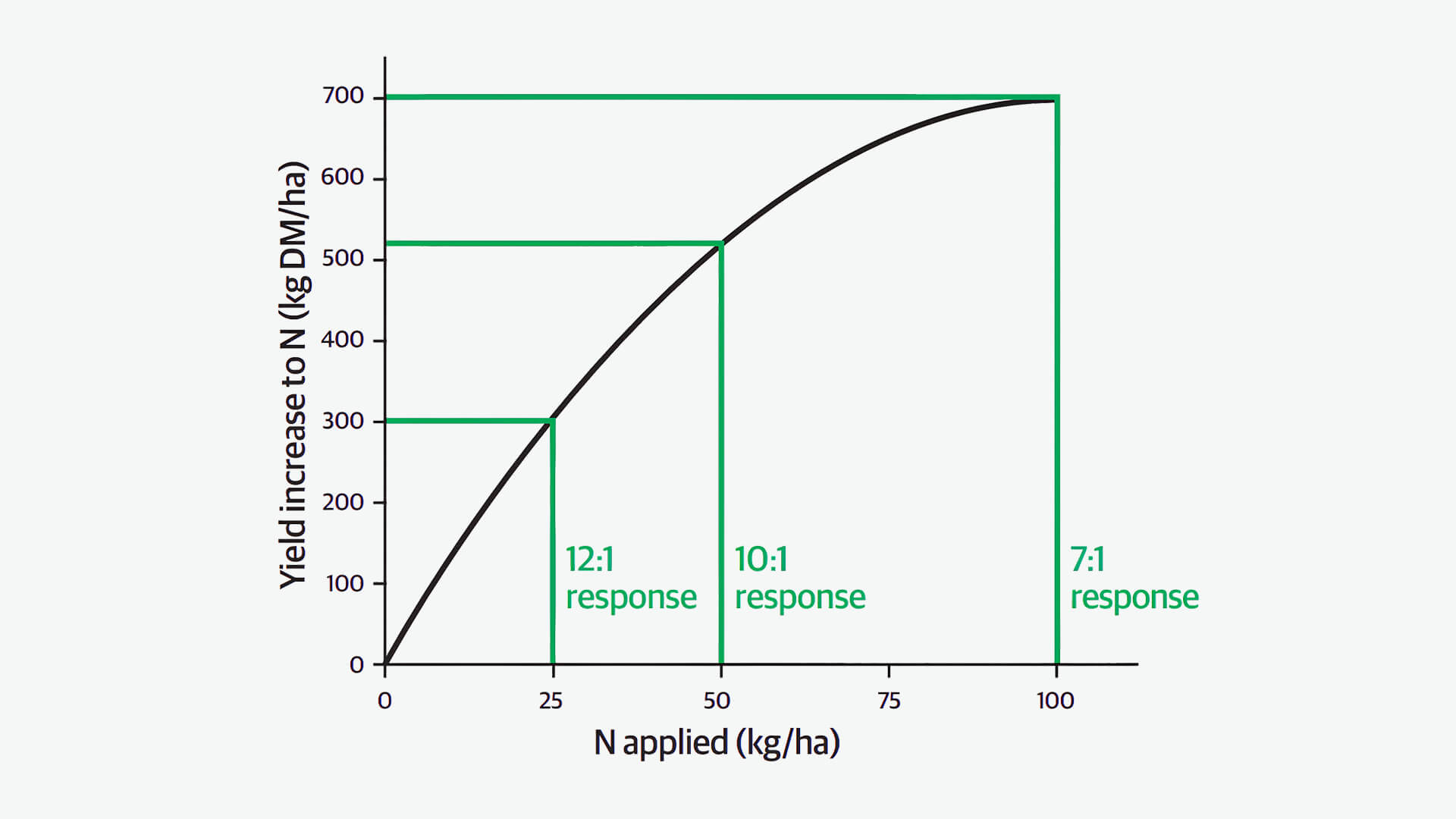
As shown above, on high fertility dairy pastures, the efficiency of pasture yield response generally declines slightly between 25 and 50 kg N/ ha but drops significantly above 50 kg/ha.
However, responses may remain linear at higher rates due to significant N deficiency in many sheep and beef pastures.
How to maximise your nitrogen fertiliser response
Nitrogen fertiliser is most effective when applied under the right conditions. Getting the timing, rate and subsequent grazing management right is key to achieving a strong pasture response.
Additional information is available for sheep and beef pastures and dairy pastures.
When to apply nitrogen fertiliser
Nitrogen fertiliser such as urea is typically applied around 3–4 weeks before additional feed is required to allow time for pasture response.
Nitrogen acts as a growth multiplier, so it should be applied when pastures are actively growing and able to respond.
What conditions affect nitrogen response?
Nitrogen fertiliser works best in conditions when:
- Pastures are actively growing.
- Soil moisture and temperature are not limiting — avoid applying below 6ºC or when soils are near wilting point or saturation.
- Useful responses often occur in late winter and early spring when soil nitrogen supply is low due to reduced clover growth and nitrogen mineralisation.
In conditions where nitrogen loss through volatilisation is more likely, such as when >10 mm of rainfall or irrigation within 8 hours of application is not guaranteed and high rates, products like N-Protect can help reduce nitrogen losses to volatilisation.
Pasture cover requirements
Nitrogen fertiliser requires sufficient pasture cover to be effective – leaf grows leaf.
- Apply when pasture cover is above approximately 1500 kg DM/ha
- Avoid applying to hard grazed paddocks
Adequate pasture cover is needed to drive photosynthesis and maximise nitrogen response.
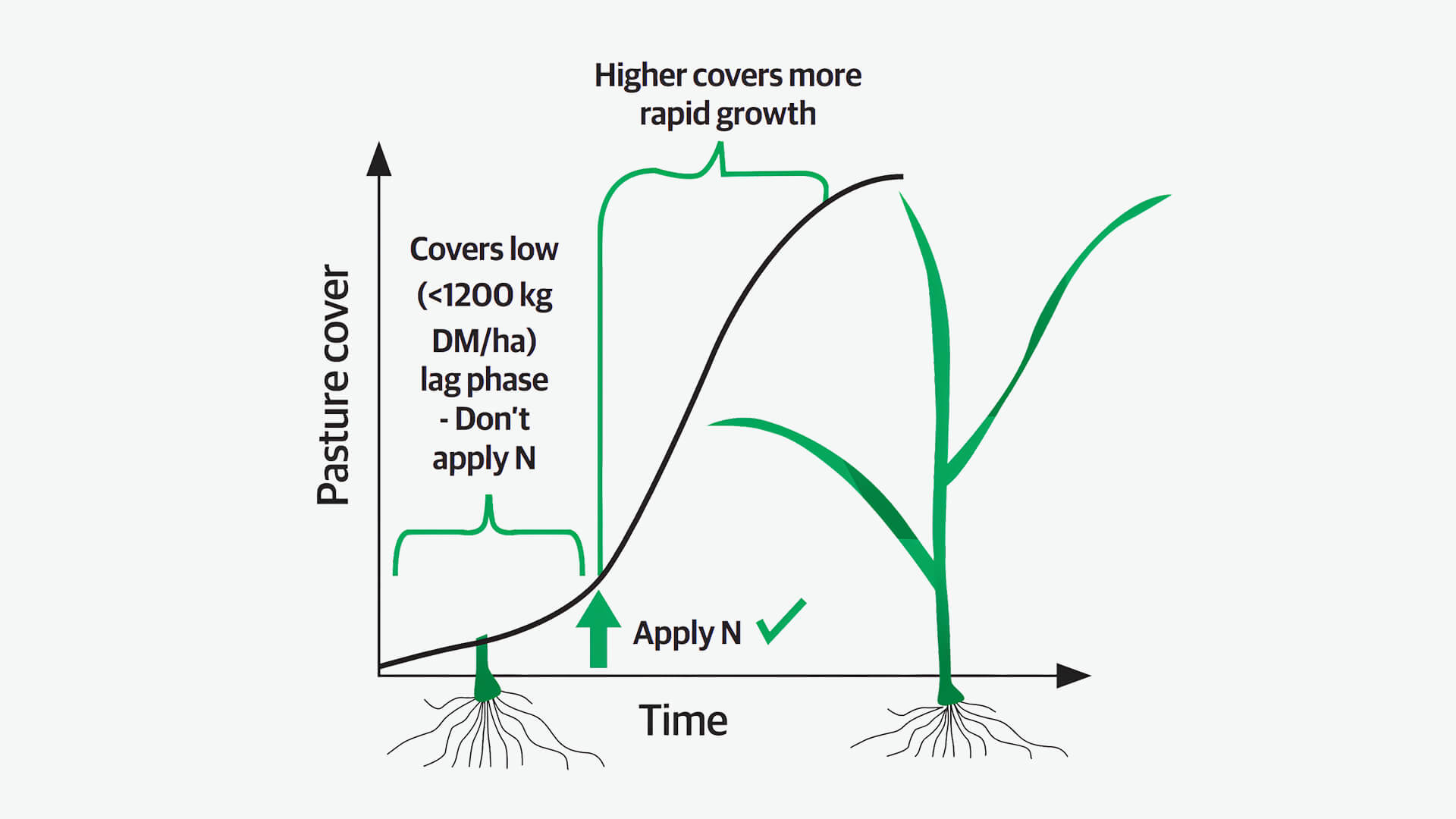
Applying nitrogen when pasture cover is too low can limit response, while adequate pasture covers allow for a better pasture growth response.
Grazing management after nitrogen application
It takes time for plants to take up nitrogen, convert it to protein and express a growth response.
- Avoid grazing for around 4 weeks after application
- Allow pasture to respond before grazing
This helps maximise the return from N fertiliser.
Improving nitrogen efficiency with N-Protect
When urea fertiliser is applied, some nitrogen can be lost to the atmosphere through ammonia volatilisation.
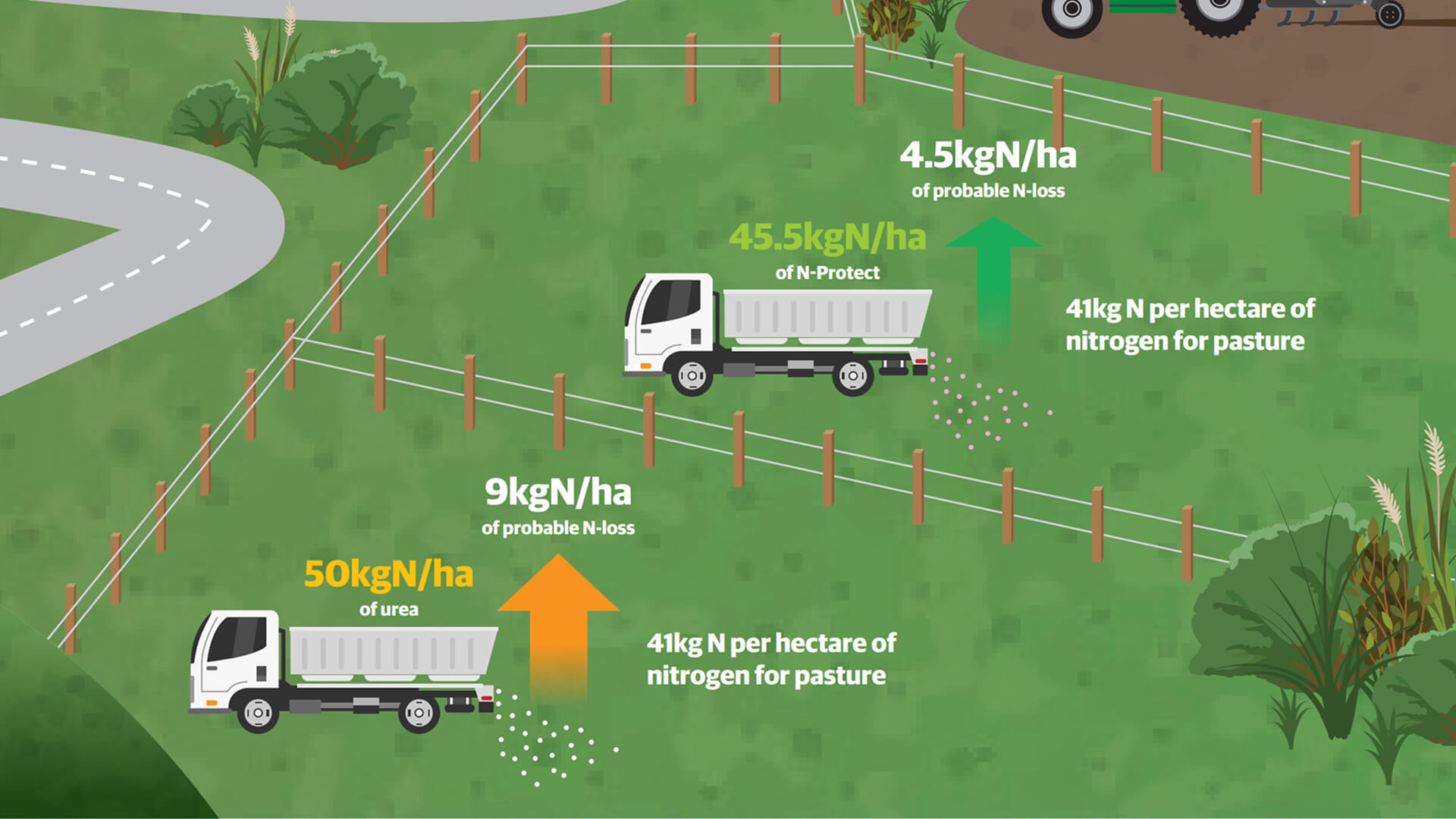
On average, 18% of nitrogen applied may be lost during spring, summer and autumn.
N-Protect is a coated urea product designed to reduce these losses by 50%*, compared to uncoated urea.
It works by reducing ammonia volatilisation, keeping more nitrogen in the soil. This means more of the applied nitrogen remains available for plant uptake, supporting pasture growth and reducing nitrogen loss.
Know what your pasture needs before applying nitrogen
Understanding pasture conditions and feed demand is key to getting a strong response.
N-Protect contains 300ppm active ingredient (NBPT). Registered pursuant to the ACVM Act 1997, No.P010198.
It is an offence to feed this product directly to animals.
A minimum 3-day withholding period for grazing, applies following N-Protect application.


