Urea vs. N-Protect: a guide to nitrogen fertiliser

Last updated: 18 June 2026
Nitrogen is a key nutrient required for plant growth and animal production. In New Zealand farming systems, nitrogen fertiliser is used to increase plant growth when nitrogen is limiting. In crops, this helps plants grow closer to their yield potential, while in pastures it is used to increase feed supply to better meet animal demand.
Urea and N‑Protect are two commonly used nitrogen fertilisers. While both supply nitrogen, N‑Protect is a coated urea product designed to reduce nitrogen loss through volatilisation, leaving more nitrogen available in the soil for plant uptake.
This guide compares urea and N-Protect, and outlines when each should be used to support pasture growth and improve nitrogen efficiency.
Contents
- What is the difference between urea and N-Protect?
- Urea vs N-Protect comparison
- When should you use N-Protect?
- When should you use urea?
- How much nitrogen is lost from urea?
What is the difference between urea and N-Protect?
The main difference between urea and N-Protect is that N-Protect is a coated urea product designed to reduce nitrogen loss through volatilisation, while standard urea is more susceptible to these losses.
Urea is a manufactured organic compound consisting of uniform white granules and provides the highest nitrogen content of any solid fertiliser available in New Zealand.
When urea is applied to the soil surface, some nitrogen can be lost to the atmosphere as ammonia. On average, 18% of nitrogen applied can be lost during spring, summer and autumn. This is a significant loss and a missed opportunity to grow more grass or to use less fertiliser through improved efficiency, this is where N-Protect comes in.
N-Protect uses a urease inhibitor coating to reduce these losses by 50%*. This coating slows the process that leads to volatilisation, helping keep more nitrogen in the soil where it can be used by plants.
Strategic Science Advisor Mike Manning (formerly Chief Science Officer) and Agri Manager Sarah Bassett explain how urea supplies nitrogen, why losses occur, and how N-Protect improves nitrogen efficiency.
Urea vs N-Protect comparison
| Feature | Urea | N-Protect |
|---|---|---|
| Nitrogen content | 46% N | 45.9% N |
| Product type | Uncoated urea granule | Urea coated with urease inhibitor |
| Nitrogen loss to volatilisation | On average 18% of N applied can be lost through volatilisation (spring–summer-autumn). | Reduces ammonia-N losses by 50%*, compared to uncoated urea. Saves an average of 9% of the N applied from being lost through volatilisation. |
| Best use conditions | When >10 mm of rainfall or irrigation can be applied within 8 hours of application or when soil incorporated. | When conditions increase volatilisation risk (when <10mm rain or irrigation occurs within 8 hours of application, high rates of N surface applied). |
| Environmental impact | Higher ammonia loss to atmosphere which can be converted to nitrous oxide (a potent GHG). | Less ammonia gas lost to the atmosphere. |
*Halves the amount of nitrogen lost as ammonia, compared to urea. Results may vary based on specific soil and environmental conditions (e.g. Soil organic matter, temperature, moisture and pH).
When should you use N-Protect?
N-Protect should be used when conditions increase the risk of nitrogen loss through volatilisation.
N-Protect is most important:
- When there is enough moisture for urea to dissolve, but not enough to wash it into the soil profile
- When you can’t ensure more than 10 mm of rainfall or irrigation within 8 hours of application
- Coupled with the above, in warm and windy conditions where volatilisation risk is higher
- When higher rates of urea are applied, particularly in cropping systems
By reducing nitrogen loss, N-Protect keeps more nitrogen in the root zone for plant uptake.
As urea prices rise, the cost advantage of N‑Protect generally increases, as the nitrogen it protects becomes more valuable.
When should you use urea?
Urea should be used when conditions for volatilisation are low:
- When urea is being soil incorporated.
- When you can ensure more than 10 mm of rainfall or irrigation within 8 hours of application – timing is crucial
How much nitrogen is lost from urea?
On average, 18% of nitrogen applied as urea can be lost through volatilisation during spring, summer and autumn.
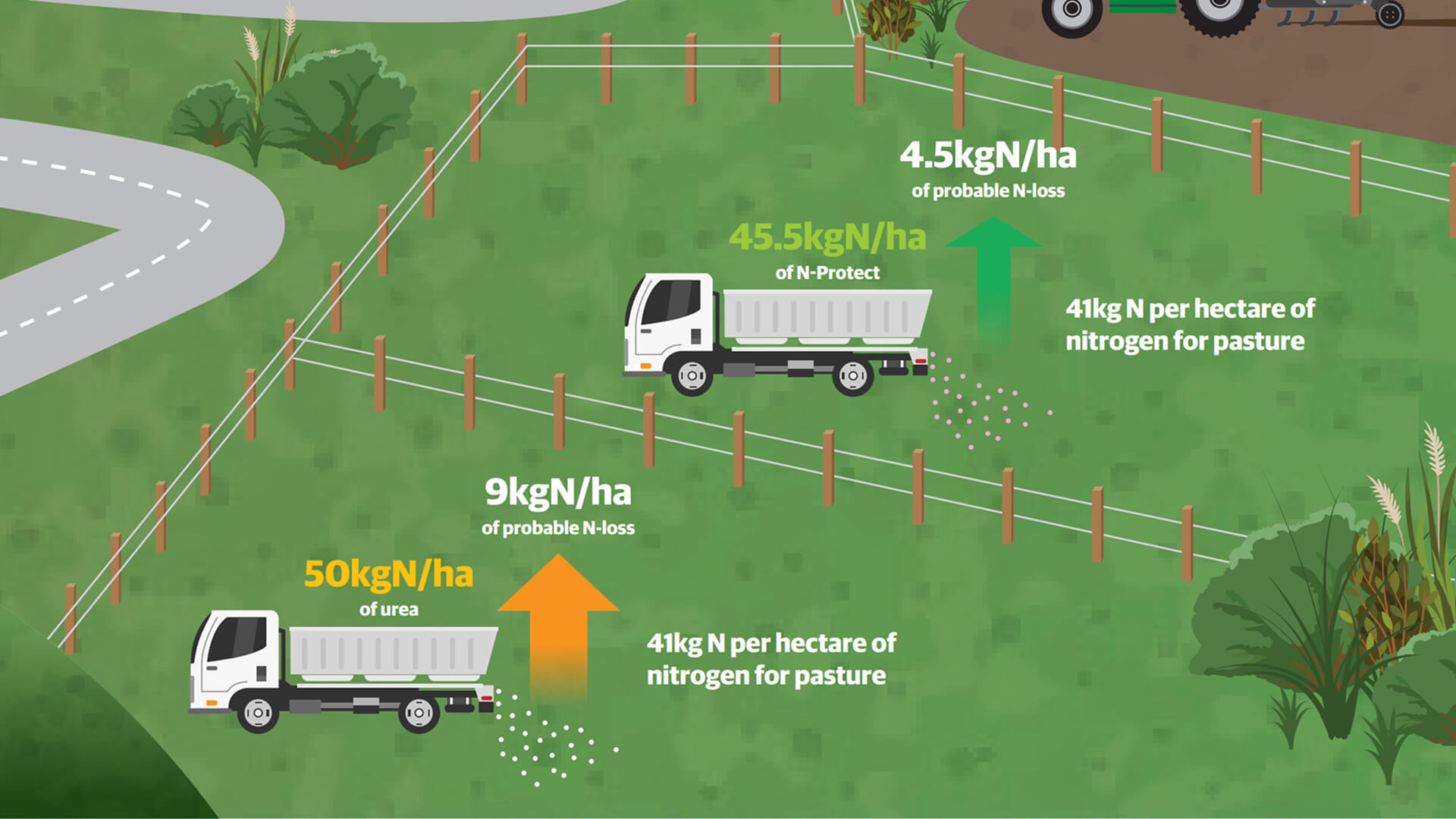
N-Protect reduces ammonia-N losses by 50%* compared to uncoated urea, meaning more nitrogen remains in the soil for plant uptake.
This improves nitrogen use efficiency and supports pasture production.
Know what your pasture needs before applying nitrogen
Understanding pasture conditions and feed demand is key to getting a strong response.
N-Protect contains 300ppm active ingredient (NBPT). Registered pursuant to the ACVM Act 1997, No.P010198.
It is an offence to feed this product directly to animals.
A minimum 3-day withholding period for grazing, applies following N-Protect application.


