Phosphorus fertiliser guide for New Zealand farmers

Updated: 18 June 2026
Most New Zealand (NZ) soils are naturally low in plant-available phosphorus (P), limiting pasture growth and animal production.
Phosphorus is essential for all life, in both plants and animals. It plays a key role in building bones and teeth and is a fundamental part of DNA, with every living cell relying on phosphorus containing cell membranes to function. In both plants and animals, it is critical for transferring energy within and between cells. Without adequate phosphorus, both pasture and animal production are constrained.
This guide breaks down how phosphorus fertiliser supports pasture and crop production in NZ. We investigate why NZ soils require P inputs, how Olsen P soil testing informs fertiliser decisions, the differences between superphosphate (SSP), triple super phosphate, diammonium phosphate (DAP), and reactive rock phosphate (RPR), and what the anion storage capacity (ASC) of your soils mean for your fertiliser use. We'll also cover the full P management process to support productivity while protecting the environment.
Contents
- What is phosphorus fertiliser?
- What does phosphorus do for our pasture composition?
- How does phosphorus affect pasture production?
- Types of phosphorus fertiliser in New Zealand
- How much phosphorus fertiliser do you need?
- Is phosphorus “locked up” in high anion storage capacity soils?
What is phosphorus fertiliser?
Most New Zealand soils are naturally low in plant available phosphorus (P), which limits pasture and animal production. Applying phosphorus fertiliser helps overcome this constraint by providing plant available P, supporting higher pasture growth and, in turn, greater animal production.
What does phosphorus do for our pasture composition?
Clovers are the basis of New Zealand’s pastoral agricultural system. They fix nitrogen (N) from the atmosphere, which is then recycled through our animals into our soils, fuelling our pasture growth.
However, clover has a smaller root system than grasses which makes it less competitive for acquiring soil nutrients in competition with companion grasses. Lifting soil fertility, in particular phosphorus levels, helps tip the balance in favour of our friend the clover.
Applying phosphorus fertiliser increases clover content in pasture swards, improving nitrogen fixation and overall feed quality.
How does phosphorus affect pasture production?
Correcting phosphorus deficiency can significantly increase pasture dry matter production compared to no fertiliser application.
Long-term fertiliser trials at Winchmore and Ballantrae demonstrate that correcting phosphorus and sulphur deficiencies can dramatically increase pasture production, clover content and earthworm populations.
The example below from Winchmore shows that superphosphate fertiliser treatments resulted in an average growth of 11–12 t DM/ha over a 31-year period, compared to around 5 t DM/ha for the no fertiliser control.
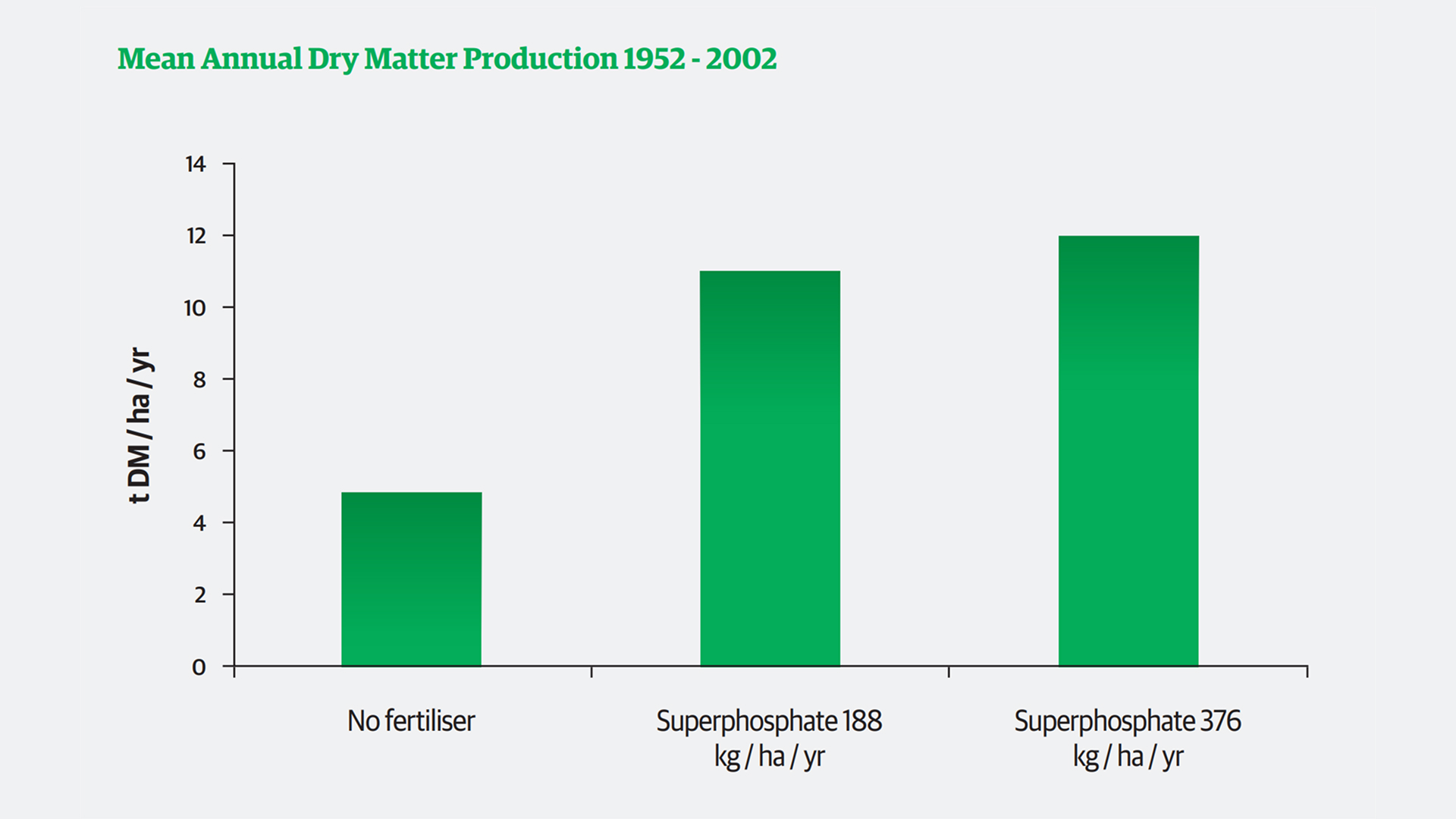
Why is there little difference between the two fertiliser treatments? At low fertility, pasture shows large responses to fertiliser because the nutrient limiting growth is being supplied. As soil fertility increases, the size of that response gets smaller, and once an optimal level is reached, additional phosphorus produces little to no extra growth because it is no longer the limiting factor. This is why soil testing and targeting the right Olsen P levels are so important.
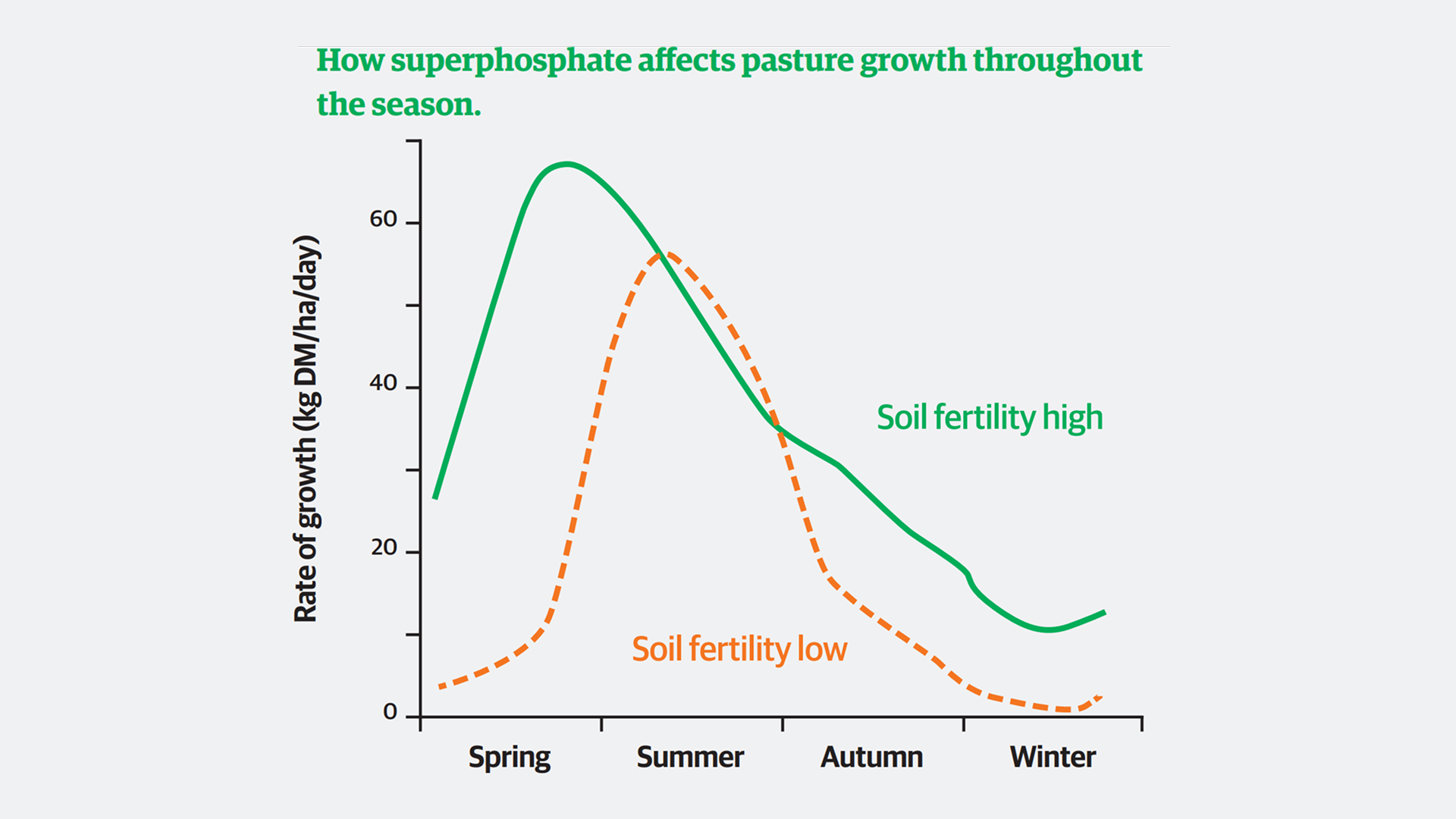
Higher soil fertility also influences how pasture grows through the season, increasing growth in the shoulder periods and better aligning pasture supply with animal demand.
Dr Ants Roberts, Science Mentor, and Sarah Bassett, Agri Manager, explain how phosphorus supports pasture, clover and animal performance in New Zealand farming systems.
Types of phosphorus fertiliser in New Zealand
Several phosphorus fertiliser products are used across NZ farming systems. The right choice depends on soil type, sulphur status, crop or pasture requirements, and management goals.
| Fertiliser | What it supplies | When to use it | Key characteristics |
|---|---|---|---|
| Superphosphate | Phosphorus (9%), Sulphur (11%), Calcium (20%) | Capital and maintenance applications in pastoral and cropping systems. | Cost-effective source of plant-available phosphorus and sulphur. Built for New Zealand soils and suitable across all farm systems. |
| Potash Super | Phosphorus, Sulphur, Potassium (varies 5–25% Potassium) | When phosphorus, sulphur and potassium are required. | Blend of Superphosphate and Potassium Chloride. Available in a range of blends to suit different potassium requirements. |
| Cropmaster DAP | Nitrogen (17.6%), Phosphorus (20%) | Cropping and pasture situations requiring nitrogen and phosphorus. | Provides readily available nitrogen and phosphate. Suitable where sulphur is not required and a short-term increase in feed supply is needed from nitrogen fertiliser. |
| Triple Super | Phosphorus (20.5%), low Sulphur | Where phosphorus is required but sulphur levels are already adequate. |
High analysis soluble phosphate fertiliser. |
| Reactive Phosphate Rock (RPR) | Phosphorus (13-16% P) (slow release) | Long-term phosphorus programmes in suitable soil conditions. | Slow-release fertiliser that dissolves over time depending on soil acidity and particle size. Often used in organic systems and where a gradual release of phosphorus is appropriate. |
How much phosphorus fertiliser do you need?
Phosphorus fertiliser is applied for two main reasons:
- Maintenance - to replace P removed in product and lost from the system, so current soil fertility and production levels are maintained.
- Capital application - to lift soil P fertility up to a target, economically optimal level. This is applied on top of maintenance requirements.
The amount of phosphorus needed for each will depend on:
- Maintenance: stocking rate and production, slope, soil type, farm dairy effluent recycling, and supplements brought onto or sold from the farm.
- Capital: the current soil fertility, the target fertility level (e.g., Olsen P), and the soil type.
Your economically optimal Olsen P will depend on how intensive your system is, and the value of extra pasture grown compared with the cost of fertiliser.
Soil testing is essential to determine whether you need capital fertiliser to build fertility or if your maintenance programme is adequately replacing nutrient losses.
Olsen P is the standard soil test used in New Zealand to measure plant-available phosphorus. Accredited soil testing laboratories, such as ARL (Analytical Research Laboratories), provide soil analysis to determine nutrient status and guide fertiliser decisions.
As soil Olsen P increases:
- At low fertility, pasture shows large responses to fertiliser because the nutrient limiting growth is being supplied.
- As soil fertility increases towards optimum, the size of that response gets smaller.
- Above optimal levels, additional P provides little to no increase in pasture production, because it is no longer the limiting factor.
Without P fertiliser inputs, soil fertility declines, which will eventually result in pasture and therefore animal production declines.
Is phosphorus “locked up” in high anion storage capacity soils?
No, some New Zealand soils, particularly volcanic ash soils in regions such as Waikato, Taranaki and Bay of Plenty, have high anion storage capacities (ASC) due to the presence of allophane clays.
The ASC test was previously known as the P retention test. This doesn’t mean high ASC (P retention) soils permanently lock up fertiliser phosphorus. Instead, phosphorus is held on the surface of soil particles in dynamic equilibrium with P in the soil solution. As plants remove phosphorus from the soil solution, more is then released from soil colloids. However, higher P fertiliser inputs may be required initially to reach target Olsen P levels in high ASC soils.
Understanding ASC helps inform appropriate fertiliser rates and expectations.
Know what your soil needs before you apply fertiliser
Knowing your Olsen P level helps you apply the right fertiliser at the right rate. Soil testing helps you manage nutrient levels, so you can grow more pasture without wasting input.


